Showing posts with label Sportlots. Show all posts

Monday, March 13, 2023

2022 Sportlots purchases: 90s and 2000s Tigers PCs

I'm back this evening with the last of my Sportlots purchases from late last year. Yep, it only took me until ::checks:: mid-March to cover my 2022 purchases!

Anyway, as we just did this past weekend it's time to spring forward and look at some cards starring players that are younger than those in part 2. Tonight's subjects are Tigers and Tigers-related PCs from the 90s and 2000s (including a small number of 2010s):

Cecil is one of the players in this post that got a very nice bump to his collection with some 19 additions, giving me a pretty nice total of 225. Since I'm not supercollecting him (as in, I'll take what I can get but I'm not actively chasing everything) I put my focus on affordable but cool looking base and inserts. There's plenty of cool to go around here with Collect-a-Books, a hologram, Sportflics, fun inserts, and more. Fleer's EMotion product is a precursor to the bordered/framed cards you still see these days.
You'll see a bit more of Big Daddy down below but the '96 foursome up top is quite cool if you ask me. Yep, we're back in the days when I loooooved Topps' products!

Two Grandersons does not equal too many Grandersons, but they're always welcome in any quantity. I think the Unique Unis insert could have been less bland but I do like the recognition for Detroit's olde English "D." The shiny Lineage parallel was a fun add too, even if it's from his time with the Evil Empire.

BInge is a Tiger I've come to appreciate a bit more lately, but I think what spurred me to collect him a bit more recently was when he joined UM's baseball coaching staff for a short time. Two of his three additions are on display here from Diamond Kings and one of Topps' many parallels.
As for Dean-o I count a massive 30 new items for his collection giving me a TCDb-dominating 469 cards. I'm now more than halfway through the wantlist I put together on the site, where I've excluded a number of issues that don't really fit my collection. This group includes some fun 90s inserts such as a '97 Studio Silver Press Proof and Ultra Gold Medallion plus a '98 Finest No-Protector parallel. The Flair Showcase card is certainly a highlight in terms of base design quality.
There's even more 90s insert-age to see here, like four different versions of his Topps Stars card, numbered between 2299 and 9799 copies. The die-cut Paramount Team Checklist is also a beaut, and who wouldn't love to see Pacific back in the game in this time of bland, thoughtless designs?
There's a few more Palmer cards below but this scan gets us through the rest of his vertically oriented stuff. The die-cut Black Diamond Reciprocal parallel and Topps Gold insert were of particular interest to me, but it was also nice to track down a cheap copy of his '01 Topps Limited base as well.

Underappreciated spark-plug Tony Phillips gets a bit more love in a scan below but right here you see him with the Angels on his '98 Score Showcase parallel, an insert that brings me back to a fun era of chasing such cards.
This purchase also boosted my Mickey Tettleton collection a bit. I'm over half the number of Froot Loops' cards documented on TCDb and maintain a huge lead when it comes to him as well. This time it was all parallels of the slugging catcher, with a pair from Stadium Club, a Collector's Choice Silver Signature, and the '97 version of Score's Showcase, another personal favorite.

Then we have the remaining six Fielder cards, all of which are landscape style. The Leaf Power Brokers and Donruss Bomb Squad inserts, the latter pairing him up with NL counterpart Andres Galarraga, highlight his ability to mash dingers. Denny's provides his second hologram card of the post. '95 Pinnacle's Museum Collection is a top 10 all-time parallel for me. I nabbed one more Sportflix issue from '95 because I've always enjoyed that product. And why not a third Score parallel as well?

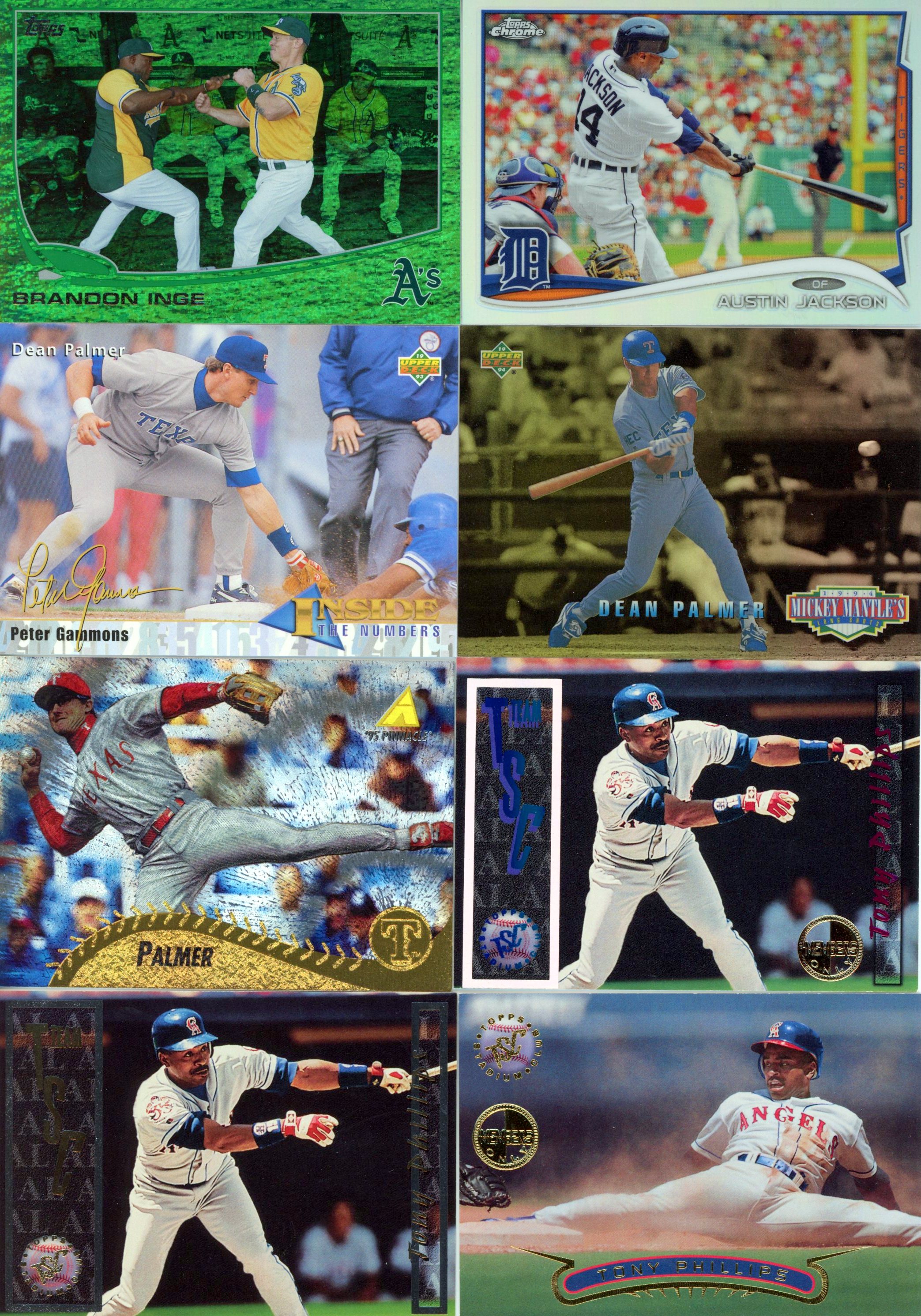
We can just about (but not quite) close things out with this scan. Inge gets one more addition in the form of an Emerald parallel, appropriately from his brief tenure in Oakland in 2012. I only scored one AJax this time but I made it count in the looks department since it's a Topps Chrome Refractor. Palmer gets a couple more interesting UD items and a '95 Pinnacle Museum Collection card of his own. I have 21 cards from that parallel and another four on my list! And Tony Phillips gets three more added to his total (257, again, a TCDb lead) thanks to Stadium Club parallels.

We're not quite done though because there's still this oversized item:

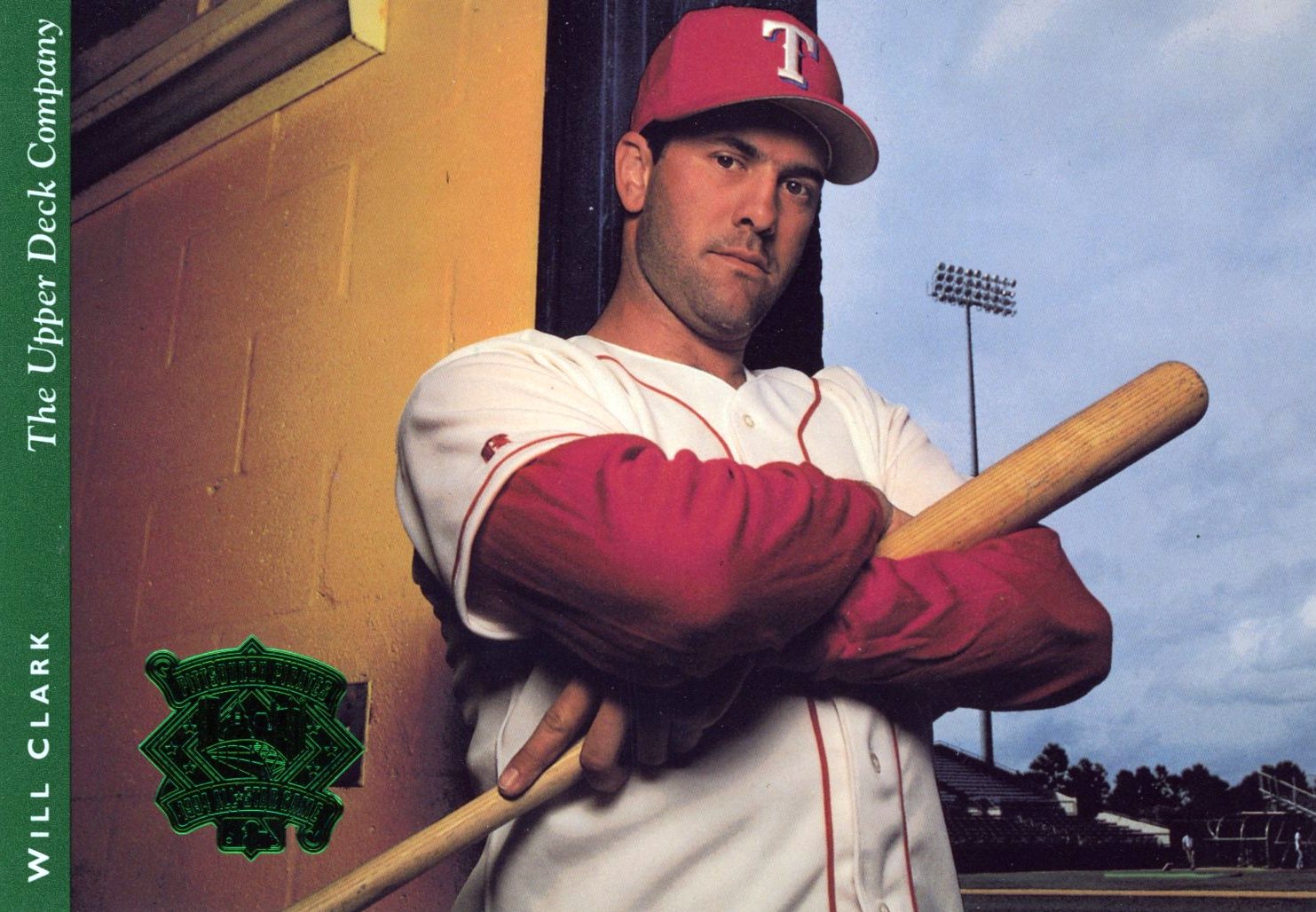
Palmer joins Barry Larkin as having one of these cards in my collection from 1994 Upper Deck All-Star Jumbos. While a chunk of the cards focused on one player, this one pairs up Dean-o with ex-Giant and new teammate for 1994 Will Clark. Palmer's fellow corner IF put up five straight All-Star seasons between 1988-92 in San Fran, and he'd make his final Midsummer Classic team in '94. Dean, for his part, put up 19 homers during that shortened campaign but wouldn't reach the All-Star game until 1998 with the Royals.

Hooray, I've finally covered all of these Sportlots additions! Next time I expect you'll be feasting your eyes on a very generous trade package from one of the coolest bloggers around, and then I'll get to my backlog of other stuff (eBay, a show, and TCDb trades, at least). Happy almost baseball season, y'all!

Wednesday, February 22, 2023

2022 Sportlots purchases: Tigers World Series heroes and HOFers

The Detroit Tigers are an old MLB franchise, starting off their history in 1901. Six years later they'd participate in their first of three straight World Series, losing a pair to the Cubs in '07 and '08 and then game 7 to the Pirates in '09. It took another 25 seasons for Detroit to return to the Fall Classic, again losing in seven games, this time to the '34 Cardinals. The following season saw Mickey Cochrane's squad avenge those first two pennant teams and win it all against the 1935 Cubs, the first of the franchise's four titles. Though they'd fall in seven again to the 1940 Reds in a 2-1 game 7 loss, Hank Greenberg's '45 Tigers would nab the Tigers' second trophy in a decade.

It would be another 23 years until the '68 team of Kaline, Horton, McLain, and Lolich would hoist the trophy, and then16 more until the wire-to-wire '84 team ate 'em up on the way to Detroit's most recent Series win. They did earn a surprise pennant in Jim Leyland's managerial debut in Motown, 2006, though the Cardinals quickly subdued that squad. And then a very talented 2012 roster brought the franchise back to the brink six years later, only to be swept by one of the three straight even-years Giants teams. Those Tigers managed two more playoff appearances the following couple seasons but have been awful since.

That means their first World Series championship drought from their inception lasted 34 years. It took just 10 to win ring number two, and 23 for the third, followed by a 16-year wait for the most recent. If 34 years sounds bad, just imagine how Tigers fans feel about next season being the 40th anniversary of their last Series victory!

With ownership giving folks nothing to cheer for over almost a decade besides Miguel Cabrera's accomplishments, at least we can look back on some of the teams of the past, including the players who earned their place in the Hall of Fame and/or were part of the four winners mentioned above. And that's exactly what we'll do this evening as represented on cards from my recent-ish Sportlots purchase:

Statistically, Cochrane is represented with the Athletics more than as a Tiger, having been part of just four Detroit teams at the end of his career. But they were certainly fruitful, as the '34 AL MVP and first-year manager led the team to the AL Pennant. The HOF catcher was no stranger to the Series, having won two in a three-year span with Philadelphia. While he wasn't victorious in try #3 in '31, nor his Detroit debut of 1934, his team would finish the job in '35 thanks to a star-studded roster that included fellow Hall members Charlie Gehringer, Goose Goslin, and Hank Greenberg. The HOF came calling after an outstanding 13-year playing career.

Speaking of Hammerin' Hank, Greenberg's second shot at October glory didn't go as well for him number-wise as the previous year, but the 1935 AL MVP posted then-career highs of 36 HR and 168 RBI, which were enough to set the table for Detroit's fall victory. Two seasons later he'd put up a ridiculous 184 RBI, followed by 58 HR in '38. Big numbers once again would earn him the AL MVP in 1940, but after a shortened '41 campaign he'd be away for three seasons due to his service in the Air Force during WWII. Remarkably he returned in 1945 having hardly missed a beat and tasted victory once again with ace Hal Newhouser earning game 5 and 7 wins over the Cubs. He'd appear for just two more seasons with a sunset appearance in Pittsburgh, but what he accomplished over parts of 13 seasons earned him a plaque in Cooperstown.

Our next player is one who missed out on postseason glory as his career--1914 and 1916-29 in Detroit--never included a Series appearance in the years before the playoffs expanded. But Harry Heilmann did win four batting titles (in a seven-year span), including a .403 mark in 1923, and he spent a good part of the '20s as the Tigers' best player on the way to a HOF nod. That makes him one of 24 former Detroit players in the Hall, and one of just 10 who spent most if not all of their career as a Tiger.

One such player who indeed spent his whole career with Detroit is, no surprise, "Mr. Tiger" Al Kaline. Kaline was on the latter half of his career as a 33-year-old in 1968, and he ceded a decent amount of playing time to OFs Willie Horton, Mickey Stanley, and Jim Northrup, plus 1B Norm Cash (in the days before the DH, of course), but he still appeared in over 100 games that season. Better yet, he hit .379 with 2 HR and 8 RBI in the seven-game Series victory over the Cards, making his first playoffs appearance count. Although his '72 team lost to Oakland, Al finished up a great career as a player and earned glory in Cooperstown.

Al's TV teammate Kell never overlapped with Mr. Tiger during their playing careers as the Philly Athletic joined Detroit in '46 and was then flipped to Boston in '52, the year before Kaline debuted. That means the 10-time All-Star 3B from Arkansas missed out on the '45 champs by a couple seasons, and in fact he never played October baseball over his 15 seasons with five total teams. His Detroit years were largely his best, though, and his seven-year run in Motown was his longest stint with any team. That's why you can find the 1983 HOF-elected Kell (hey, that's the year I was born!) wearing the Olde English "D" on his plaque.

Lemon is one of three players in this post representing the most recent title team from 1984. The CF for the team that went on an amazing run, his 6.2 bWAR was second only to Alan Trammell's 6.8. A 1972 first-round pick for Oakland, he was sent to the White Sox in 1975, and then Detroit acquired him after the 1981 season for Steve Kemp. The Tigers easily won that deal and got nine valuable seasons out of Chester. Though he contributed just a run on no hits in the ALCS against the Royals, he'd be more useful in the Fall Classic itself. Though he's no HOF, he put up a sneaky good 55.6 bWAR and will go down in history as a World Series champ.

Should we talk about the next two guys together? Why not? McLain and Lolich were the aces of the '68 team with 31 and 17 wins, respectively. Denny was in his 6th of eight seasons with Detroit, then he'd finish up his career with Washington, Oakland, and Atlanta. Mickey was a few years older but also in his 6th season as a Tiger, and he'd play seven more with that team before his career ended with the Mets and Padres.

Before that, they were a big reason for the success of the 1968 team. McLain's 31-6 record (with 28 CG) earned him the AL MVP/Cy Young duo, and though he lost World Series games 1 and 10 (both to Bob Gibson), his game 6 victory brought the series back even after St. Louis took a 3-1 lead. Meanwhile, Lolich won all three of his starts, games 2, 5, and 7, and he even hit a homer to help his own cause in game 2! He was the obvious choice for Series MVP after going 3-0 with 3 CG and just five earned runs allowed. Neither did much of note after leaving Detroit, but their combined '68 season will forever be a part of franchise lore.
Jack Morris is '84 Tiger #2 in this post, and his first two World Series appearances were tales for the ages. He threw an early-season no-hitter in 1984 as his team stormed to a Fall Classic matchup with the Padres. All Black Jack did was throw two complete games in games 1 and 4, both wins, giving up a paltry 4 ER in his 18.0 IP. If that wasn't enough for his legacy, he went 4-0 in five postseason starts with the Twins in '91, allowing a ridiculous 3 ER in three Series starts against Atlanta, two of which were wins, including his legendary 10-inning 1-0 shutout in game 7. You'd better believe he was the MVP of that one. Toronto picked him up for the '93 season and he was back on the biggest stage in October, though this time he went 0-3 in the ALCS and World Series, though he snagged a ring with the Jays anyway. His body of work, especially his postseason success, finally earned him entry into Cooperstown in 2018.

A few decades earlier, Detroit-born ace Hal Newhouser was the one dominating things from the mound. While he went just 34-52 his first five seasons, he ripped off a 151-80 run over the next seven, beginning in 1944, and those years included consecutive MVP nods in '44 and '45 and a second place finish in '46. Though he didn't pitch in the 1940 Series loss to the Reds, things would be different in 1945 as he went 2-1 with game 5 and 7 victories over the Cubs. Prince Hal spent parts of 15 seasons in Detroit, winning exactly 200 games plus the accolades listed above. He then signed with Cleveland where he played his last two Major League seasons (1954-55). With the Indians he allowed a run out of the 'pen in the four game sweep at the hands of the Giants. Like Morris, he was elected to the HOF as a Tiger, not to mention one who won a ring in Motown.

And tonight's last player is the Big Wheel, Lance Parrish. Embodying the '84 team's strength up the middle, the 1974 first-round catcher socked a career-high 33 homers in his third of five straight All-Star appearances (out of eight total) while winning his fourth (of six) Silver Slugger award and second of three straight Gold Gloves. When you have a catcher playing like that, you're going places! And that's exactly what this team did thanks to his two homers and five RBI in the playoffs. One of those bombs went against Goose Gossage in the 7th inning of game 5 of the World Series, an inning before Gossage refused to walk Kirk Gibson and allowed his second jack of the game, putting a bow on the Series for the Tigers. Lance spent parts of 10 quality seasons with Detroit before ownership got cheap and let him walk after 1986. He'd then spend the remaining nine seasons of his career with six other teams, most notably the Phillies for two years and the Angels for four. A Hall of Famer he wasn't, but the Big Wheel formed a formidable 80s battery with fellow stalwart Jack Morris.
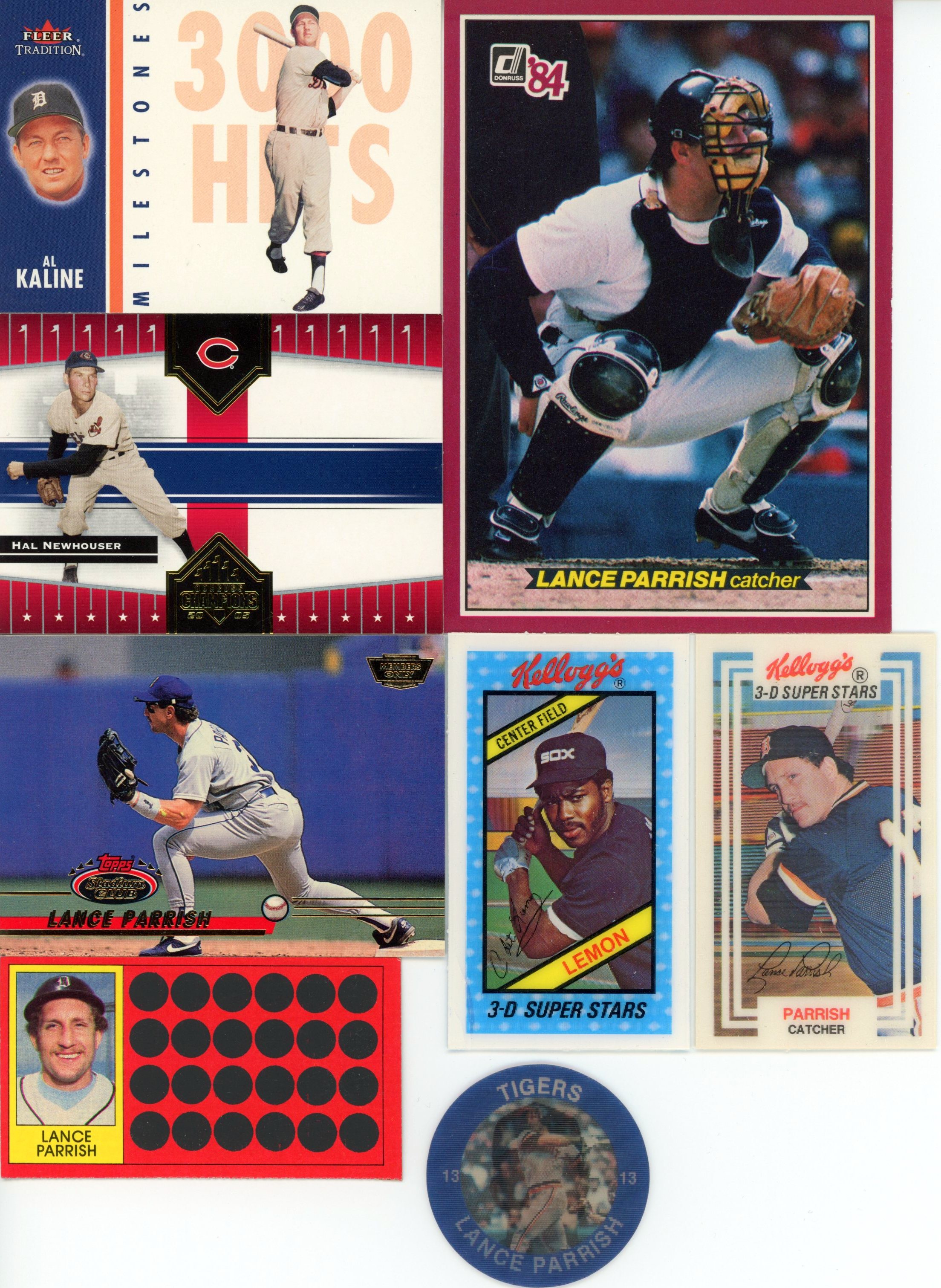
Since I covered everyone in this scan, please enjoy some interesting items of a few players that were already discussed. A sweet Kaline insert, a Donruss issue of Hal with Cleveland, and a Lance Parrish parallel were the lone horizontal cards in this group. Parrish pops up a few more times on some fun oddballs including an oversized Donruss piece, Topps Scratch Off, Kellogg's hologram, and 7-11 coin. '84 OF Chet Lemon joins the Kellogg's fun with a pre-Tigers issue as well.

I put a lot more time and effort into this post while deciding to focus on the careers of the players instead of discussing the cards, and I hope that work shows! For my part, while I don't usually like to take this long putting together posts, it was lots of fun looking back at some of the HOFers and World Series heroes of my favorite MLB team. What do you all think? Any favorite players or sets here?

I'll be back with one more post in this series but I have a ton of other stuff to cover so I'm not quite sure when you'll get the finale. Either way, you can count on seeing LOTS more cardboard here soon.

Thursday, February 2, 2023

2022 Sportlots purchases: the Michigan stuff

We've hit February and I've got a show to get to in a couple days so tonight I've decided to start covering the Sportlots cards I purchased at the end of 2022. I've split them up into three groups so I don't drag out getting them posted for too long, and tonight you get to see the Michigan Baseball and Football PC cards I nabbed from there:

Scan #1 starts with my 12th different Jeff Criswell. You also see four of the six Cronenworths I picked up there (with two way down below), from a few different variations of '21 and '22 Topps. At some point I should compare how many Drew Henson baseball cards I have versus football, out of the 100+ in his collection. And it feels like I pick up lower-end cards of Hill far less often than I should be able to, so these two and the pair in the next scan felt like a win for me.
The other two Hill cards joined the Rainbow Foil parallel out of '20 Update, and those are Royal Blue and Yellow inserts. Also, as you can see, I definitely didn't neglect my Larkin collection (930 cards strong!) with the seven cards you see here to go with three more near the bottom. Sometimes I think '96 Topps Chrome doesn't get as much love as it deserves compared to the initial version of Finest but maybe that's just a nostalgia thing for me. Speaking of loving Chrome, the '21 Stadium Club card looks excellent as a perfect combo of the two.
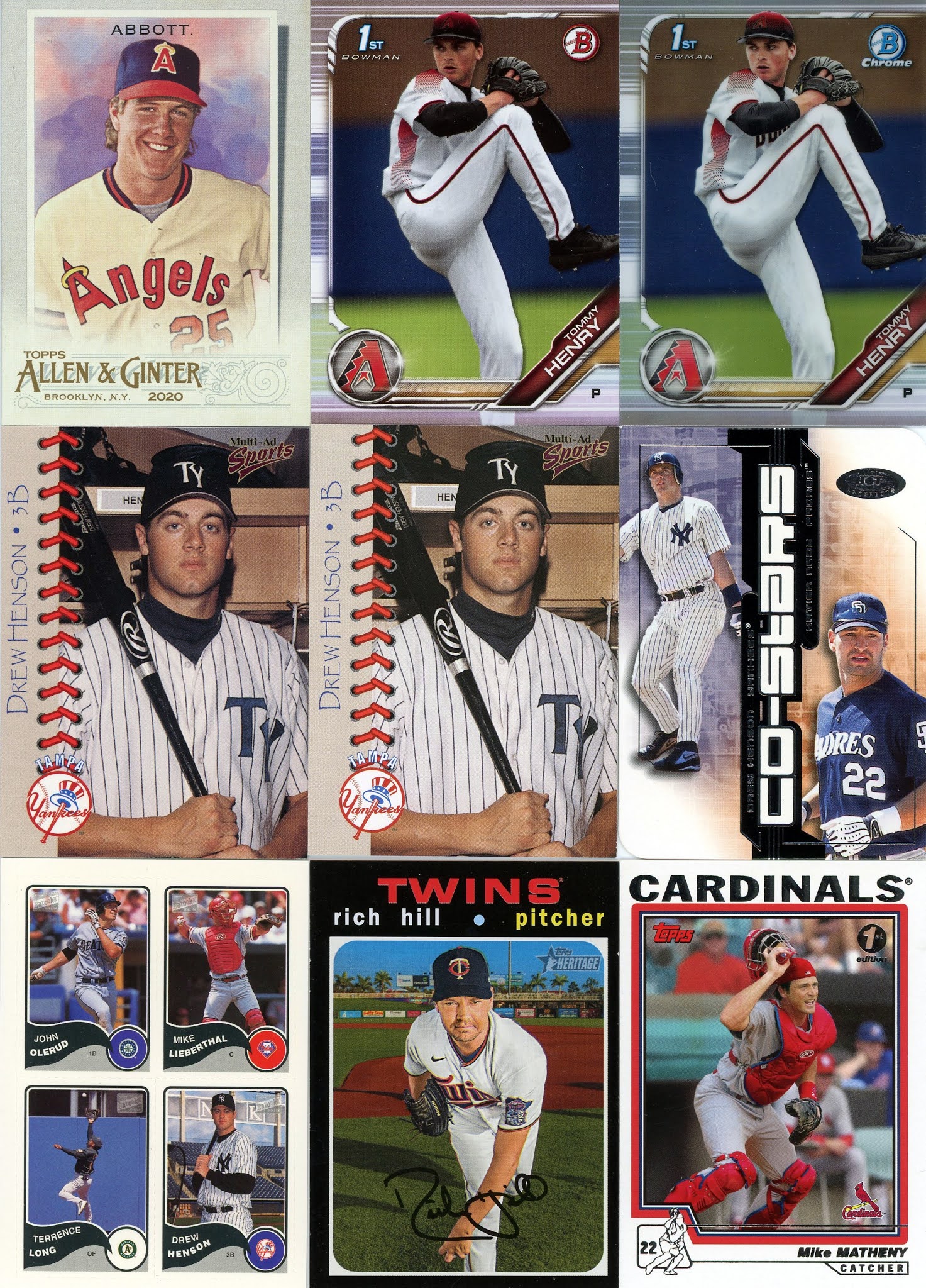
Sportlots has been a good source for parallel versions that seem overly expensive elsewhere, like the Topps Limited and First Edition cards of Matheny above. Hal Morris demonstrates some fun options we had back in the 90s out of Leaf Fractal Matrix, Pacific Online (Web Card! Yep, the ones with the codes), and the Gold version of '99 Topps Stars, #d /2299. Putz's sickly green parallel came out of the 2014 product. And Clayton Richard gets in on the parallel fun with Rainbow Foil, Limited, and 582 Montgomery Collection cards, plus another one in the next scan.
Another Richard parallel and another team too as the Blue Jay appears in Topps' 150th Anniversary insert. Meanwhile, my collection of Branch Rickey is very small at just eight cards, but it was much smaller before these additions so I was glad to bolster the collection of the former Wolverine and innovator of the game. How could you possibly go wrong with products like SP Legendary Cuts and TCMA?

There ends the regular sized vertical stuff but I added a few oddball items as well, and I'm happy to report you'll see similar items scattered across the other two posts. To Larkin's collection I added an '89 Panini Sticker, which I probably pulled from a pack and stuck in the album when I was about six, plus a couple tiny Topps Micro cards. Then I got full-on oddball with a 1984 7-11 Coin of Ted "Simba" Simmons. While I'm much more familiar with the most recent offerings from the convenience store, namely the 2000 set, I have just a few of the coins from the 80s so I love adding fun pieces like this one!

The baseball group is complete with this six-pack of horizontals. My tiny collection of Bourque increases by one thanks to another Rainbow Foil parallel. A shared Padres card that includes Cronenworth gets a couple appearances thanks to 582 Club and Star versions. My Tommy Henry PC nears double digits with a Heritage Minors issue from 2020. It's pretty rare to find new items of Ryan LaMarre that I need right now, but I did track down a '17 Topps All-Star Game factory set version. And Rickey gets one last look on a classic UD card depicting him with recent birthday boy and monumental baseball innovator Jackie Robinson.
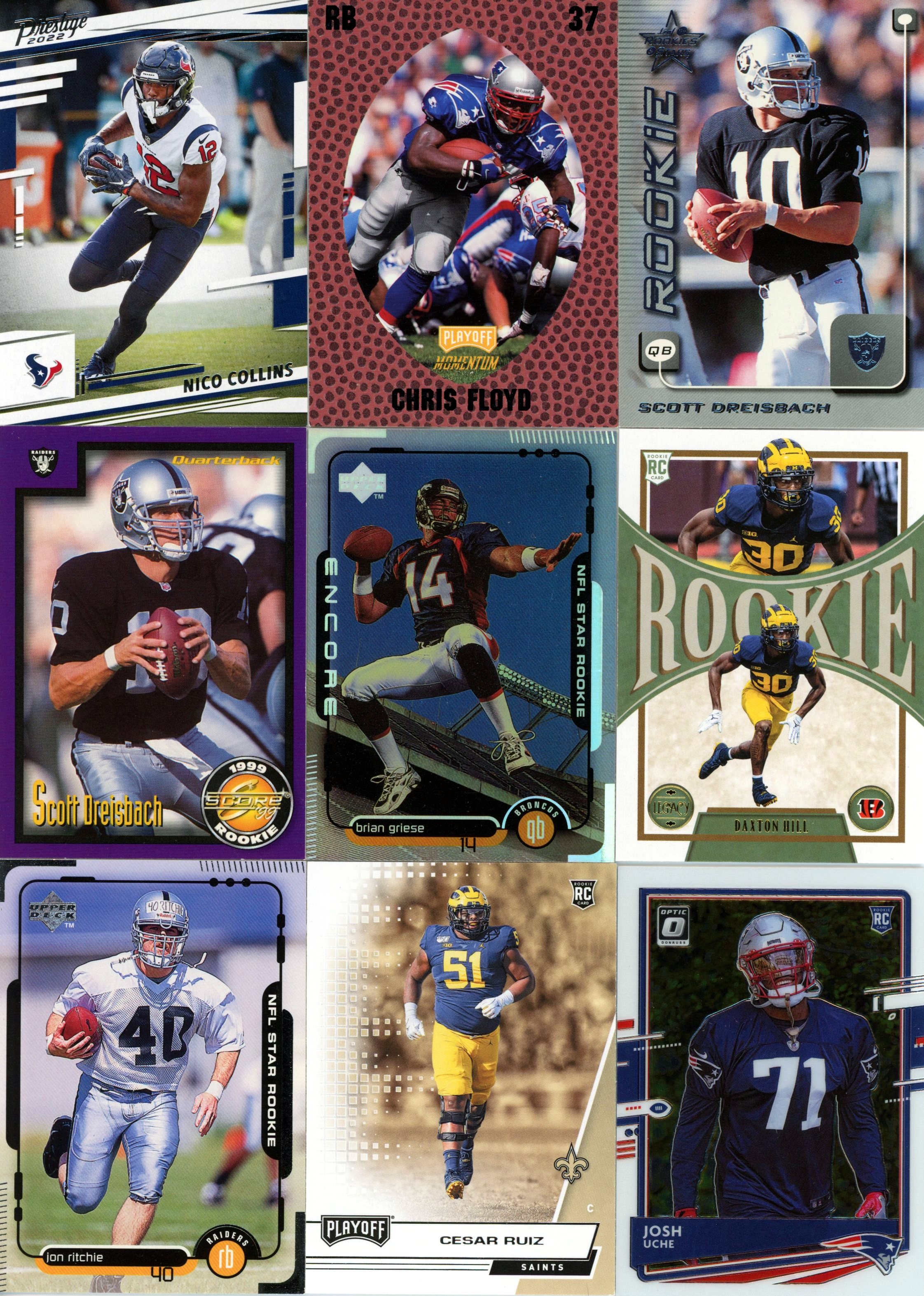
To those I added nine football cards, all of which are rookies except for the Collins, which I must have added by mistake since his '22 Prestige card would be a second-year (but is still much appreciated). Other than that, let's pretend I scanned the rest in order. QB Scott Dreisbach has four RCs I'm chasing and I picked up my first two out of '99 Leaf Rookies & Stars and Score Supplemental, so I'm happy to welcome him to the Rookie Blue project. Floyd's Playoff Momentum Retail is the 10th card in his collection and seventh of eight first-years that I need. Fellow '98 guy Griese is down to just five missing rookies out of 39 with the addition of the shiny Upper Deck Encore you see above.

Bengals rookie DB Dax Hill is the first of two Michigan uni cards, and his '22 Panini Legacy RC is my second such card of a guy who just missed out on a rookie-year Super Bowl appearance. Transfer RB Jon Ritchie is yet another '98 guy and I'm chasing four of his 12 rookies after picking up his '98 UD base. Saints OL Ruiz is the other college uni guy tonight, and the '20 Playoff of #51 is the third of seven cards I need, which is actually a decent number for an offensive lineman! Finally, Pats LB Josh Uche, who had two three-sack games this season, sees a '20 Donruss Optic RC added to his bunch, number five of the 13 I need to complete his run.

I'm quite happy with the variety I picked up that you see before you this evening and I'm looking forward to seeing what people think of the other two groups as well, so watch for those soon!

Sunday, July 25, 2021

2021 Sportlots purchases part 10: 100% '84

Previously: Quick summary and set wantsBig and small we have them all!Better off TedA Tettle-ton of Froot LoopsLucky Tiger SevenDizzying DeansSportlots has been Barry, Barry good to memore Michigan? Marvelous!Tony the Tiger

Well here's a post that's been a long time coming. I'm finally wrapping up the huge Sportlots haul I picked up earlier this year, and I'm excited to be doing it with today's theme: the 1984 World Champion Detroit Tigers!

A few of the guys you'll see today previously appeared in this series' second post that covered all sorts of stickers, minis, and other oddballs, but besides those I scored a bunch of (generally) more standard stuff of some of my favorite members of the Wire-to-Wire Champs:


The first scan features three subjects, and we begin alphabetically with Sparky, the first manager to win a World Series in both leagues. He led Detroit to glory in his sixth season with the club after winning four pennants and two rings with the Reds. I added six cards to his collection (more later), and the four you see here are all from the early part of his 17-year Tigers career: 1981, '82, and '83 Donruss, plus an '84 Fleer team checklist. I also bought what should have been a variation of the '83 card, but the seller must have had it mislabeled since it was the same as the other I grabbed. No big deal, though, these are still fun early 80s issues of the guy that managed my favorite team as I watched them growing up.

Next, Evans was an addition to the team as a free agent in late '83 and he'd prove to be an important contributor the following year, though his best Detroit seasons would come the following three years. I added three interesting items to his collection, starting with a pair of Topps box bottom cards from 1989 and '90. I think they were a cool inclusion for collectors back then, and fun pickups now as I chase his checklist. Those are joined by a '94 Upper Deck All-Time Heroes base that combines black & white photos with a bit of a throwback design. It's fun seeing Darrell with his second and third franchises on the front as I know him best as a Tiger, but he spent more years in San Francisco (eight) and of course, Atlanta (nine), than the five he was with Detroit.

Last up in this scan is dramatic World Series home run guy Kirk Gibson; Decline to walk him at your peril if you're a racist MAGAt reliever. Since Gibby was a guy I started supercollecting before I knew what that was I'm quite surprised I didn't have his '95 Topps Cyberstats parallel, but that was easily rectified here. And speaking of his legendary Fall Classic performances, I came up with his Tigers entry in Donruss' 2004 World Series Blue insert to go along with the Dodgers one. You'll see the third item I picked up of him below.
Next is a guy who dominates the next two scans just like he dominated during the regular and post-season in '84. HOF P Jack Morris threw two complete games against the Padres in the Series to win his first of three rings after earning 19 dubs (including a no-hitter) earlier in the year. This scan and the next two include a total of 19 new items for his collection, one of the larger of my Tigers PCs. All but four feature him with Detroit because I didn't feel like paying $0.18+ for non-Tigers cards, though I'm still happy to acquire them otherwise.

This scan covers the 1981-93 stuff, which means it includes stats from his second, third, and fourth full seasons as a starter (he appeared in 28 games in '79 but only started seven of those). The '81s include the debuts of Donruss and Fleer, Topps (because I somehow didn't have that), and Topps' Coke Team Sets. The Coke card is my second from the Tigers set to go along with Kirk Gibson. As with the '81 version, I somehow didn't own Morris' '82 Topps base before this, but now I do! The '83s are a pair of Donruss cards, including a Diamond King(!), plus Fleer and OPC. The back of the DK refers to "The 27 year old" as "the ace of the Detroit pitching staff for the last four seasons", and considering he averaged 16 wins person year in that span, I think that's fair.
In this scan we get through the rest of the 80s stuff before jumping to stuff that's a bit more modern. Jack's 1984 cards include his stats from the previous season, during which he won 20 games for the first of three seasons ('89 and '92). The top three cards in this group were printed the year Detroit last won it all, and they include Donruss, Fleer, and Topps' Glossy Send-In All-Stars. The '85 Donruss card appears to be the last mainstream one I needed of the ones made the year after the Roar of '84, leaving me chasing some boxed sets and oddball-type stuff.

The next four are the only non-Tigers cards I grabbed because they were too cool to avoid. First is '92 Triple Play's Gallery of Stars, another Perez-Steele collaboration that makes them all but Diamond Kings. Two '94s capture his sunset season with the Indians: a Pinnacle Museum Collection and Sportflics Rookie/Traded base. That's one of my all-time favorite parallels plus a brand I love combined with the rookie/traded theme, so they were obvious takes. And last up in the group is a 2001 Topps Traded Gold parallel of Morris' base card in a subset that reprinted earlier Topps Traded issues. It's #d /2001, continuing that year's flagship product's debut of the Gold parallel as we currently know it.

And then we're back to a Detroit card, at least in terms of the uniform and team listed, if not the subject. As I mentioned, Morris came up aces in the '84 Series, but his gutsy 10-inning complete game in 1991's Game 7 combined with his victory in game 1 over Atlanta earned him the Series MVP. At that point he was 4-0 in five Series starts, though he'd go 0-2 in a rematch with the Braves the following year as a member of the champion Blue Jays. Regardless, that legendary '91 performance earned him the final card in this scan from Donruss' 2003 Champions set.
Scan #1 included three of the most important '84 Tigers, and so does this one! Morris finishes off his post-dominating run with a base from one of my favorite Upper Deck product lines: Sweet Spot (Classic, from 2003, in this case).

I also managed to grab a few cards of Detroit's iconic double-play pairing, Tram and Sweet Lou. The HOF SS's cards here are from '95 SP Championship's Die-Cut parallel (giving me all four of his appearances in the product), '95 Stadium Club Virtual Reality Members Only, '96 Donruss, and 2020 Topps Archives. Once again I'm in disbelief that I lacked such a basic card as Tram's '96 Donruss, but that was easily rectified. We'll see Tram again shortly, but for now I'll mention once again that I like 2020 Archives' callback to the 2002 flagship design.

Sweet Lou one of two today is from one of the same sets a Trammell from above came from. 1995 Stadium Club continued its Members Only parallel, and that year it introduced Virtual Reality, the product's answer to flagship's Cyberstats insert that attempted to extrapolate full stats for the shortened season. Topps mashed the two together into Virtual Reality Members Only, a third insert, and the result is what you see above.
I think I have to name this scan my favorite of the bunch by default since it includes four of the guys previously discussed today, including a pair of slick '90s inserts (which, of course rule, so that tag is once again in effect today!).

Sparky gets a multi-photo '85 Fleer Superstar Special subset demonstrating "giving the signs", and then a super cool 2002 Fleer Greats Dueling Duos insert with another managing legend, Earl Weaver. The back explains that the two faced off in the 1970 World Series, with the third-year Weaver's Orioles defeating Sparky's Reds in his managing debut. These guys combined for 43 seasons as managers, earning 3674 wins, nine pennants, and four titles (one for Weaver). I like the classic look of that insert, not to mention the pairing.

And then there's the other three players I said you'd see again. Gibby returns thanks to the pinnacle of the Pinnacle brand--its 1995 product and the highly sought after Artist's Proof parallel. The foil has faded from gold to something more like silver over the years, but it's still awesome. Tram's other appearance is another Stadium Club parallel: 1994's Golden Rainbow, with the lone difference being the gold/rainbow foil in the Label Maker-like player name section. And Sweet Lou's appearance in the super cool 1994 Triple Play Medalists insert is a textbook example of knowing what to look for before searching Sportlots, because that very card won't appear under a "Lou Whitaker" search (instead the description reads "Alomar|Baerga|Whitaker"). The card itself is another fun 90s insert, highlighting the best in each league by position, even if it's now off-putting to see the recently disgraced Alomar on it.

Well, just like the 1984 season, this was definitely a wild ride that ended in success! Another huge Sportlots foray is in the books, and now I can get to other stacks of cards on my desk from a blogger trade, eBay, and a TCDB deal, plus who knows what else to come?

Sunday, June 27, 2021

2021 Sportlots purchases part 9: Tony the Tiger

Previously: Quick summary and set wantsBig and small we have them all!Better off TedA Tettle-ton of Froot LoopsLucky Tiger SevenDizzying DeansSportlots has been Barry, Barry good to me; more Michigan? Marvelous!

One of the many reasons I'm glad I've evolved into a player collector over the years is how rewarding it can be to relive a favorite athlete's career through their cards. Tony Phillips is a guy I remember enjoying watching during my younger days, especially during his stint with the Tigers, and as I've repeated a number of times here, I've come to appreciate his game even more as I've gotten older.

One of his most defining characteristics was his versatility, and if you needed any evidence of that beyond, say, his Baseball-Reference page, pay attention as you scan through the cards I picked up from Sportlots below and witness the crazy number and combinations of positions listed on the fronts: OF comes up the most with 2B not too far behind, and you'll also see standards like SS, 3B, and LF. But don't forget SS/2B, 3B/OF, IF/DH, IF/OF, OF/2B, and OF/2B/3B! This guy played around 1/3 of his career in the outfield with most of the rest of his time spent in the middle infield and 3B, plus he could get on base (including walks) and score runs, and occasionally he even offered a bit of pop. Put him anywhere in the lineup and you're all set!

In the spirit of the late Keith Anthony Phillips' many facets, please enjoy this look at a huge variety of cards I added to his collection thanks to Sportlots:

We'll start all the way back the year I was born: 1983. Because the rules for such cards are goofy, the 1983 Topps Traded that kicks off this scan is generally not considered a RC, but an "XRC". Whatever, it's still his first Major League card and it shows him hitting in one of his 40 appearances in 1982. By the way, did you know he was actually drafted by Montreal #10 overall in the 1978 January secondary draft (way back when they had those), then traded to the Padres in 1980, and then to Oakland in 1981?

After that is a pair of '84s, including his Donruss RC (which gives me all three of them) and one of a bevy of food issues you've enjoyed this series: Topps' collaboration with Nestle. Tony can be seen smiling, as he often was, on his Fleer base from the following year.

The rest of the cards in this group are glossy/Tiffany versions of cards I already had the base versions of from 1987-89. They're difficult to discern from a scan like this and even sometimes in-hand so I try to remember to put them in penny sleeves to remind myself and avoid tossing them as dupes.
Now we're into the 90s stuff where we pretty much spend the rest of the post. The top row isn't too exciting with 1990's Donruss Best of the AL, Fleer Canadian, and Topps Traded Tiffany. Under that, though, we have 1992 Bowman and Topps Gold sandwiching two very nice inserts from the same year: Donruss's Diamond Kings and Leaf's Black Gold. The artwork for the DKs always looked amazing but I really like the brand's switch to the different card stock and foil accents here. Then from '93, in addition to Pacific Spanish, I added Phillips to my collection of that year's OG Finest set. I may be searching forever for affordable versions of the iconic Refractors, but otherwise I'm pretty much done with the set save for the biggest guys like Griffey/Gwynn/Maddux/Ripken.
1993's representatives include a Select Stat Leaders insert, Stadium Club Members Only parallel, and three different Topps flagship versions: Gold plus the Inaugural Marlins and Rockies cards. How did Phillips pile up 114 runs to lead the AL in 1992 on a team that went 75-87? It helped that he got on base at a .387 clip with an outstanding 114 walks, but just as importantly, the lineup was stacked with power, with Mickey Tettleton, Cecil Fielder, Lou Whitaker, Travis Fryman, and Rob Deer combining for 138 bombs and 438 RBI. Also, can we talk about how amazing that photo is from the Stadium Club card, with a throwback uni-bedecked Phillips defying gravity to turn two while Fryman looks on? Topps may whiff on the images they use in flagship, but Stadium Club never misses.

Anyway, it's time to move on to '94 with the super premium Flair, a very different O-Pee-Chee look (starring another smiling Tony!), and the first of a multi-year Pinnacle run that I still love to this day. I would have been excited enough with the debut of the Dufex Museum Collection parallel at the end of the scan, but I also tracked down Tony's Artist's Proof version. I don't think I can emphasize how tough the latter was to find back then, so they still feel special to me today when I can find them for a fairly reasonable $1 each.
We need 2/3 of this scan to finish up 1994, and that's mostly because of parallels. We start with Score's Gold Rush, then move on to the second year of UD's SP, plus its die-cut version, followed by the Members Only parallel of Stadium Club, an issue from the 50-card confusingly named Members Only boxed set, and finally, Topps Gold. It's kind of funny looking at the Score parallel and SP base and realizing they have pretty much the same kind of gold thing going on!

1994 was Tony's last season with the Tigers so some of the '95 cards start showing him with his next team, the Angels. While the Collector's Choice SE Silver Signature and first of two Finest cards in a row show him with Detroit, a Collector's Choice base from the "traded" section depicts him with California, just as the same subset has his former teammate Tettleton with the Rangers. Tony would bop a career-high 27 homers with the '95 Angels.
A graph of the increase in sets from the various manufacturers must have looked like a vertical line back then because this scan is all 1995 and it doesn't even cover everything from that year! Finest Series II captures Phillips with his new team while one of Fleer's goofiest designs uses a very similar photo, albeit with the Tigers, giving us a look at how consistent his hitting mechanics were. One of my favorite Leaf designs shows some batting action that serves as a reminder that Tony was a switch-hitter, further upping his versatility.

Inserts down the middle here include Score's return of the Gold Rush parallel along with Hall of Gold, an insert found in both series that focused on some of the bigger stars of the game. And SP's third year included another parallel, but instead of going the die-cut route, Upper Deck went with a shinier Silver foil on the left side of its insert that's also known as "Superbafoil". If you're still counting, there's another smilin' Tony!

The bottom row's first card reminds me that while the '96 version will forever be my favorite Sportflix product, '95's looked awesome too, and I'm quite happy with how Phillips' card scanned here. That's joined by another example of Stadium Club's Members Only boxed set (called "Members Only 50" this time), and Topps' foiltastic Cyberstats parallel, which attempts to extrapolate stats for the strike-shortened '94 season.
Ok, now we can finally finish up '95, with an Upper Deck trio. Tony looks like he's about to make some solid contact on his UD flagship and Electric Diamond parallels, and then we get one more happy moment with the Tigers thanks to the Special Edition product.

In contrast, 1996 can be summed up in the remaining six cards. Four of those happen to come from Fleer: the matted and embossed Emotion-XL, flagship and its Tiffany parallel, and a White Sox team set. I really like the way Fleer did the matte cards plus glossy versions in '96 and '97. Also, the White Sox come into play here as Tony spent '95 with the Angels, signed with Chicago the following January, then returned to the newly-named Anaheim franchise in '97. Speaking of the ChiSox, you get another issue with them thanks to a Finest subset that focuses on trades. Then, for the third straight year, Phillips made the Stadium Club boxed set, which again added the "50" to its name to denote the set size.
1997 makes up a perfect nine-card scan here. Both his Leaf base and the crazy Fractal Matrix version capture him back with the Angels, and I'm happy that with the Matrix Bronze card out of the way I just need to find a Die-Cut version. Pacific's offering that year isn't great in my book, but they came up with some solid designs pretty soon after. Both Score and its foiled up Showcase parallel feature Tony looking a bit alarmed about something mid-swing. He was perfect for Studio, especially one of the best versions of it, and proves that with another smile. Don't call the Ghostbusters--that Chrome card isn't nearly as haunted as it scanned. That year's Gallery is typically excellent, and it's a shame it's his only appearance in the product. And I love the big leg kick and pinstriped uni in Ultra's Gold Medallion version, which I'll remind everyone includes a different photo than the base, something that doesn't typically happen with a "parallel".
Here we have the last of the verticals and first of the horizontal cards. As often happens when there's a bunch of scanning involved I goofed up by flipping the two Y-axis cards, so Ultra's '98 Gold Medallion should have been first followed by 2000 MLB Showdown Unlimited, which captures Tony back with Oakland on his final mainstream card made during his career (which ended in 1999), along with the 1st Edition and a couple inserts.

The horizontal contingent opens with Phillips about to make a great play, back with Detroit, on a '94 UD Electric Diamond parallel. That's followed by '95's Collector's Choice Silver Signature and the high-end Flair. We won't be ending on cards with him as a Tiger, but this trio is still nice to see near the end of this evening's post.
Speaking of endings, here we are with the final scan, and boy does it start with a bang. I don't think I need to repeat how much I love 1995 Pinnacle and here I have both the Artist's Proof and Museum Collection versions. I already mentioned how tough the APs were back then, and I prefer that year's Dufex parallel above all other versions. The fact that he has a great horizontal action photo here is a big bonus.

As for the rest, Studio's credit card-themed set also represents 1995. Stadium Club's Team Stadium Club base subset, plus a Silver parallel, are from 1996. Like I said, Pacific did better after the '97 set that didn't do much for me, and the '98 set feels like a step in the right direction. Phillips spent 1998 with the Blue Jays and Mets, with whom he's seen on his '99 Fleer Tradition base and parallels, such as the red-foiled Warning Track parallel above, though it also mentions that Oakland signed him as a free agent. And fittingly, the final card here has him back with the franchise for whom he played the most games and seasons, Oakland. That would be Pacific's Omega product, also from '99, which comes with two images up front, one of which is used both in an inset photo and in a foiled area on the far right.

This haul of one of my favorite former Tigers gave his collection a huge bump, and I now own 242 different cards of Phillips, putting him at #15 among baseball players I have on TCDB, so hooray for a new milestone. I also became the undisputed #1 collector of Phillips cards on the site, something that's been happening more and more often as I continue to put my effort into collecting players few others chase:

Just as I'd hoped, it was fun not only strengthening one of my favorite PCs, but enjoying looking at some very cool brands and inserts at the same time, so I'm glad I unintentionally made Tony the last of the single-player posts in this series.

You can expect the final one, which some of you will be roaring about, fairly soon, but first I need to log and scan those cards, and I appear to have a couple envelopes heading to my mailbox in the near future, so I'm not exactly sure yet when you'll be seeing the finale. As for me, I'm happy to be putting away even more cards from this huge Sportlots purchase, freeing up a bit more room on my desk!

Saturday, June 19, 2021

2021 Sportlots purchases part 8: more Michigan? Marvelous!

Previously: Quick summary and set wantsBig and small we have them all!Better off TedA Tettle-ton of Froot LoopsLucky Tiger SevenDizzying DeansSportlots has been Barry, Barry good to me

Just two posts left after this one! Tonight's will be another group post instead of a single player like the last one, though we're sticking with Michigan Baseball as the theme. I believe I counted 17 different players in the scans below, enough that I originally considered splitting them up, but I'm feeling motivated to finish these up. Therefore, it's more Michigan mania!

We'll start with this group since I found a lone new card for all nine players. Up top are three of the older Wolverines you'll see today: 1976 SSPCs of P Jim Burton and OF Tom Grieve, plus a '78 TCMA of 1B/OF (and UM football player as well) John Herrnstein. Burton's '78 SSPC card will sew up his four-card run whenever I can find it. Herrnstein's collection will be tougher to complete because, as a reminder, he shares '60s rookie star cards with Willie Stargell and Dick Allen.

The next four are some of the latest Michigan alumni to make their pro debuts. Blomgren, Criswell, and Franklin (2020 Bowman Draft) were all selected in the first five rounds of the '20 draft, while Brewer (2020 Topps Heritage Minors) was a Houston 3rd rounder the year before. They're all pretty good prospects, and these items represent my first for each player except Criswell (my 4th).

A couple "S" players close out the scan. First is a 2011 Triple Threads Sepia parallel (#d /625) of HOFer George Sisler, giving me 99 different items of "Gorgeous" George. The other continues the run of oddballs, especially of the food issue variety (foodballs?) in this series: an '81 Topps Coca-Cola St. Louis Cardinals issue of P Lary Sorensen. Aside from the obvious Coke logo up front and different numbering on the back, these are very similar to the base cards, but still fun pickups for your everyday player or oddball collector.

Jim Abbott got the biggest boost in numbers to his collection of the players you'll see today, and this group of nine isn't even all of them. The scan is bookended by food issues from Topps/Bazooka's 1990 partnership plus 1993 Kraft, a pop-up I won't be popping up myself. Also from 1990, starring a poorly chosen photo emblematic of the junk wax era, is Donruss' Learning Series, a 55-card set geared towards elementary- and middle-schoolers.

Then things get Canuckified with 1990 Fleer Canadian and O-Pee-Chee, a couple issues from our friendly neighbors to the north. That Fleer photo was another bad choice, to be sure. A pair of Classic cards produced in 1991 and '92 look much better to me since action shots almost always trump portraits in my opinion, plus it's always really cool to see portions of Jim's one-armed delivery. Last up here is a pair of '93 Upper Deck Gold Hologram cards, which are annoying to have to track down as a player-collector, but then I suppose they do give me a reason to collect a second version of a card where Abbott's wearing a Michigan shirt! You'll see one more of these below since he was all over that '93 set.
One last Abbott (for now) gives way to a few slightly more recent guys. I found a new pair of cards of Portage, Michigan native and 2019 Arizona draftee Tommy Henry: his Bowman Draft and Draft Chrome Refractor issues. It's always nice when I can track down stuff with backs that mention Michigan in one form or another, such as these that include his college stats.

Drew Henson is a player whose cards I get to chase in two sports, and here I have four of the five from this purchase. The first couple are from 1999 team sets for New York's Tampa affiliate, with the second apparently hailing from an "update" set that's almost identical. The '02 Hot Prospects insert he shares with another guy that had some hype behind him, Xavier Nady, is pretty cool thanks to a pair of rounded corners. And to those I added a four-player 2003 Bazooka sticker whose players happen to appear in the order of best MLB career to worst!

You'll see more of both of the other guys in this scan in a minute, but interestingly enough they're both still involved with the game despite their ages. Old Rich Hill turned 41 a few months ago but is still pitching pretty well, though of course those efforts are now for the Rays instead of the Twins, with whom he appears on his 2020 Topps Heritage base. And former Cardinals C and manager Mike Matheny made the relatively short trip to Kansas City to helm the Royals after being let go by St. Louis, the team pictured on his 2004 Topps 1st Edition parallel above.
The other Matheny cards I found were both from 2005. The first is also a 1st Edition version of his Topps flagship base, and it offers and even better action photo than the previous year's. I wonder if an out resulted from that throw? The other is the Silver parallel from Total, which wasn't as good as the 2002-03 versions in my opinion, so I'm not really disappointed the brand disappeared until the bastardized cash grab online version resurrected the name in 2019.

The rest of this scan stars William Harold Morris, and almost everything I scored of Hal this time was of the oddball variety, but that worked for me as a fun way to beef up his PC a bit. Here you see a trio of Classic cards from 1989 and '91, a 1991 Baseball Cards Magazine issue done up in the style of '66 Topps, and Morris' three appearances in a Rembrandt/Ultra-Pro promo set put out in '92. The latter was a 20-card set featuring casual shots of some baseball stars (such as Bobby Bonilla and Jose Canseco), mainly focusing on their favorite pastimes, such as tennis for the guy above. The backs included Ultra Pro holograms and a message of the "limited" nature of the cards; the ones you see here received 125,000, 250,000, and 100,000 copies, respectively.
Two more Morris cards get me just a pair shy of 300 for his collection. The first is from the US Playing Card Company's 1992 Baseball Aces deck, and it's only natural that someone playing for the Reds should be assigned a suit of that color. The other is the only "mainstream" card in his bunch, his '95 Collector's Choice Silver Signature parallel, making him the fourth Wolverine I've found from that set (Steve Ontiveros, Steve Howe, and Scott Kamieniecki are the others).

Player #2 in this scan is Hal's former teammate Chris Sabo, and as with Morris I came away with '89 and '91 Classic issues of "Spuds". You can add him to the food issue club as well thanks to a '92 Jimmy Dean oddball from an 18-card set that also included Jim Abbott among its stars. Lastly, also from 1992 is a goofy design (and funny photo of Sabo utilizing a hitting training aid) from Topps Kids. If you care for whatever reason, the latter is the variation that has two asterisks in the trademark line instead of one.

It seems like a good idea to mention that this post will be published on Juneteenth as we look at the last player in the group of vertical cards. Moses Fleetwood "Fleet" Walker was a C for Toledo of the old American Association, considered a "major league", back in 1884, making him the first black player (or just "the first black in the majors" according to the cringe-y back of the 1986 Fritsch Negro League Baseball Stars card you see on the left) to break the color barrier. That makes Jackie Robinson's bravery in 1947 no less important, though, as he fought through the same kind of ignorance and hate that Walker did. While you won't find him on too many cards, unfortunately, another of his items can be found relatively easily: a base card from Upper Deck's 1994 product Baseball: the American Epic, which describes Fleet's history a bit more intelligently.
To finish things up today, here's a six-pack for your weekend. First up is the final Jim Abbott Gold Hologram from 1992 Upper Deck, a set that included lots of those artsy cards. My Tommy Henry collection grows by one more thanks to a cool 2020 Topps Pro Debut base that makes good use of the card's orientation. A multiplayer card including fellow Yankees prospects from the time Juan Rivera and Jackson Melian is Drew Henson's other appearance from the Minors team sets mentioned above. I got two cards closer to Rich Hill's 2020 Topps rainbow with his base card and Gold Star (factory set) parallel, not to mention two more cards from his year with the Twins. And lastly, Sabo joins Morris in needing just two more cards for a milestone (he's at 198) thanks to one last food issue: a 1992 French's card he shares with HOFer Wade Boggs. I've never been a mustard guy but that 19-card set full of All-Stars is fun and I may have to try to track down more of those.

Considering these additions combined with those from some of the earlier posts in this series, I got a lot of good work done on the checklists of some of the many former Wolverines I collect, and added some fun pieces.

Still to come in the final two posts are one more single-player feature plus a last one with a team theme that I think will please many of you!

Sunday, June 13, 2021

2021 Sportlots purchases part 7: Sportlots has been Barry, Barry good to me

Previously: Quick summary and set wantsBig and small we have them all!Better off TedA Tettle-ton of Froot LoopsLucky Tiger Seven; Dizzying Deans

Time to get back to the Sportlots piles! I'm actually almost done as I'm planning on something like three more posts after this one: two groups and one single player. This evening's post will be of the latter type, focusing on the #3 player in my collections, Barry Larkin.

Because I generally stuck to the minimum $0.18 price point and due to the fact that I already had a lot of Larkins (more on the total at the end of this post), nothing you'll see today is that big of a deal. That said, there's lots of 90s stuff, which is often my favorite, and I like to track down pretty much anything I need of the former Michigan/Reds HOF SS.

So here's a look at some Barry nice cards:


When you already have lots of a guy's lower-end mainstream base stuff, what better direction to go in than oddballs? I've always been a Coke guy but I like the 1992 Diet Pepsi card that kicks off this post. Similarly, I don't think I've ever had Church's Chicken, but the collaboration they did with Panini back in 1994 resulted in a pretty cool item.

I was able to fill some base card holes in his PC, though, such as '93 Ultra (how did I not have that?), '98 Pacific and Upper Deck Special F/X, and 2000 Topps Stars. The Special F/X card looks great but just doesn't scan well due to being especially foil-y. The effect looks very nice on what was already a solid base design in my opinion. Also, the back of the Stars card rates Barry on a scale of 1-5 stars in hitting (4), power (3), speed (4), defense (5), and arm (3). I've got no complaints with any of those, but then again this was back when Topps apparently employed people that cared about making great cards.

As for inserts in this scan, well, they're right down the middle, like a meatball clobbered by Barry for one of his 198 career dingers. I consider 1996 Collector's Choice an improvement over the previous two years of the product, and from that one I came up with one of his Silver Signature parallels plus one of his two You Make the Play card game insert appearances (the other is a stolen base card, apt since he swiped a career-high 51 in '95 and then became the first SS to join the 30-30 club the following year). Then we have a Swing For the Fences insert from 1997 Pinnacle X-Press. His 33 jacks in 1996 were tops for his career, justifying his presence here, though for most of his MLB tenure he was more like a 10-15 homer guy.
This next group spans 2000-2018, which is cool because over the whole post I found cards that were made between 1992 and 2020. First up is another instance of Ultra's die-cut Gold Medallion parallel from 2000, one of two years they did that for their baseball product. 2002's cards include a slick looking Topps Chrome design plus UD's Ballpark Idols and Victory, with the latter definitely having a bit more staying power. Before a jump of more than a decade, take a look at cards from 2004's Leaf and Topps Total. The former is from the Passing Through Time subset, which includes the same front photo as his earlier card in the base set, but a back that's a reprint of his '93 Leaf base--kind of a nice feature.

The bottom row has three cards that were made much more recently by Panini. First is a USA Baseball Stars & Stripes Longevity insert--as opposed to the Longevity base cards also available in the product. WHY, PANINI, WHY?!--produced in 2017. Barry, of course, played for Team USA at the '84 Olympics with baseball as a demonstration sport, and he helped his team to the equivalent of a silver medal after the team lost to Japan in the final. I now own six cards of him suiting up for his country. The others here are from 2018 Donruss and its chromed-out Optic version, both of which come with a nice photo of him following through on a swing.
This last scan includes the horizontal cards before returning to the final part of verticals. I just felt like it would look cleaner that way, so that's the order I'll talk about them here.

The '95 Flair card that leads off this scan is a good example of what that higher-end product went for, and I'm glad all these years later that they're so cheap to acquire considering their quality. Joining it from the same year is Score's Gold Rush parallel, which I think looked better the following year but is still quite nice in the form you see above.

And now, how about a trio of die-cuts? Upper Deck's SPx came on the scene with a bang in 1996 thanks to its super premium hologram/die-cut combo, and in my opinion, it got even better with its sophomore effort, giving it pleasing curves on one side and an "X" cut on the other. That gem is joined by two years of Pacific's Crown Royale: 1999 and 2000. I prefer the team coloring and the interesting font on the newer card more myself but both are done in the set's cool crown motif very effectively, and I'm glad Barry was still considered baseball royalty and made the cut (no pun intended) those years.

The final horizontal card here is a 2018 A&G insert called Fantasy Goldmine. I do find it odd that Topps chose to highlight WAR, a stat that I've never seen used in fantasy baseball, plus I'm not sure where they got their number--Barry's the owner of 70.5 bWAR and 67 fWAR. Either way, he earned that number thanks to both a good bat and glove.

Finally, we have a pair of 2020 Topps-branded base. One of them is once again Allen & Ginter, which looks like a typical example of that product, though I do like the Reds jersey they used for the image. Much better in my eyes is Larkin's 2020 Archives base as it uses the 2002 Topps design. I was a fan of the brand way back then because it didn't suck like it does now, and I recall having fun opening at least one box of each series that year since it was, you know, affordable and fun. I'm sure some of my love for the design is nostalgia-based, but in general it's just easy on the eyes too.

Now that I've covered each card you see scanned here I can announce that I've hit a few new milestone for my Larkin collection: 800 cards! Thanks to Sportlots I now have 807 of Barry's issues, good for third place in my baseball collection as I mentioned earlier:
I sure wouldn't mind getting him over that 1000 card mark like Ripken (and, soon enough, Griffey), so I'll continue working at it via my favorite card acquisition sources.

Those of you who've enjoyed any part of this series can look forward to roughly three more posts, as stated earlier, and I hope those will capture your interest as well!

Wednesday, June 2, 2021

2021 Sportlots purchases part 6: Dizzying Deans

Previously: Quick summary and set wantsBig and small we have them all!Better off TedA Tettle-ton of Froot Loops; Lucky Tiger Seven

Tonight's post is definitely the largest in the series in terms of quantity of cards, but I'm going to do my best to get through it quickly and let the scans mostly speak for themselves. That's partially because I don't want to get hung up writing something that's too long--I'd love to get these cards put away and on to the next post--plus I have a show coming up this weekend, and I have a super cool new Facebook purchase to show off that I'm looking forward to posting.

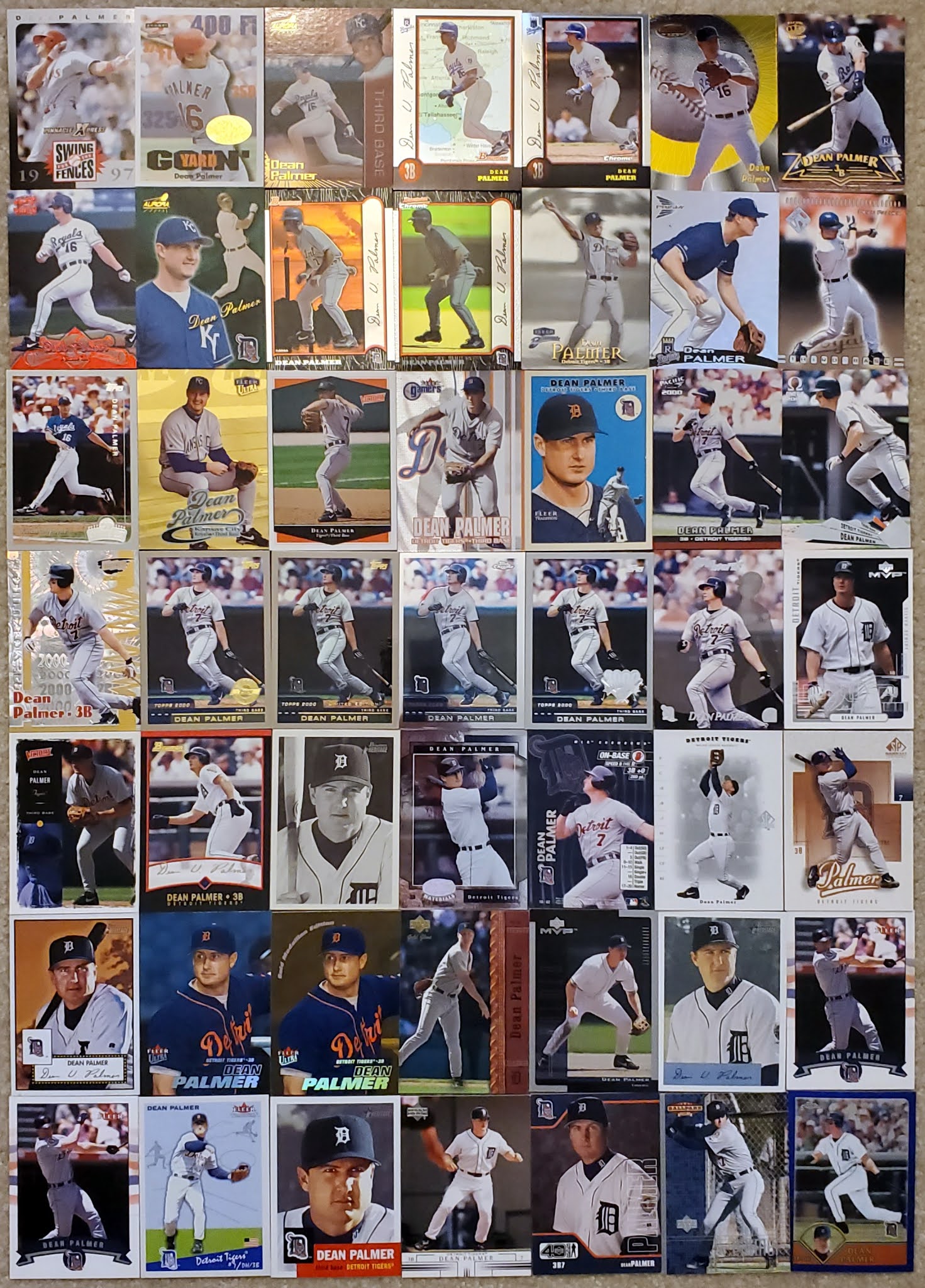
So let's get to this evening's subject. I'm not quite sure what made me decide to PC Dean Palmer, a 3B who mostly played in the 90s for Texas, KC, and then Detroit. He spent his last five seasons with the Tigers but only two of those were full years--he'd appear in just 87 games from 2001 to his sunset season of 2003. Still, he was kind of a highlight on some of those awful Detroit teams, continuing to show the pop he did with the Rangers and Royals by putting up 38 and 29 bombs and 100 and 102 RBI in '99 and 2000. If anything, it's probably a combination of his power, brief Tigers tenure, and the fact that most of his cards hail from my favorite hobby era: the mid-90s to the mid-aughts.

So here's a look at the roughly 180 items I added via Sportlots. I picked five scans worth of vertical cards and one of horizontals to highlight, then covered the rest via photos. Honestly, who wants to look at 20 scans of Dean Palmer cards?

Here's a lot of Deans:

To start with I picked one of a few Minors issues I grabbed this time, opting for the one you see because I thought "89ers" was a great example of fun farm team nicknames. There's also pairs of Sportflics (the first a RC), black inserts, Finest (OG '93 and '94), and sweet Pinnacle dufex inserts. Don't worry, there's plenty more "90s inserts rule" goodness where that came from!
In terms of the base here we continue the Finest run with '95 while adding the following year's artistic E-MotionXL, the non-autographed Leaf Signature, and Topps Chrome version 1.0, which I think ended up looking quite nice despite the original product being relatively boring. Everything else is a parallel, from '95 Summit's Nth Degree and '96's Donruss Press Proof, Fleer Tiffany, Score Dugout Collection, and Ultra Gold Medallion. The Press Proof was one of the costlier cards in my cart at a buck but I thought it was worth it.

This scan may be my favorite of the bunch with a who's who of 90s giants of design and shininess. '97 includes two versions of the eye-popping color brought by Flair Showcase, the artistic visions of Studio and Topps Gallery, and a high-flying Palmer on Topps Chrome's excellent sophomore effort. Not to be outdone, 1998 starts very strongly thanks to Fleer's amazing E-X2001, and the bar stays high with Finest (having skipped a couple years I already had), another gorgeous Flair Showcase base, and lastly Pacific's "I dare you to try to ignore me" Revolution.
Are you enjoying seeing all these high-end brands? Then you'll like these too! SP Authentic's had a number of looks and '98's is one of the best. That year's Gold Label pops just like the Showcase cards that keep coming up in this post. We go back to the UD well a couple more times to finish up 1998 with the "hobby" version of the 10th Anniversary Preview (I own the retail set), plus the higher-end parallel of the flagship product, called Special F/X. 1999 opens with beautiful designs and familiar names like Finest, Flair Showcase (x2) and Topps Chrome (more acrobatics from Palmer!) plus Fleer's Mystique, a product where you got to peel opaque film from a number of mystery cards.
And here we have the last of the scanned vertical stuff. Don't ask me how a '98 Sports Illustrated card ended up dead center in a scan with cards from 2000-01, I couldn't tell you. In terms of base stuff, that joins some very nice offerings from 2001 Bowman's Best, Finest, Studio, Topps Fusion, and Topps HD. I believe I've said a few times how much I admire Fusion, which used gorgeous designs from Bowman's Best, Finest, Gallery, Gold Label, and Stadium Club--some of Topps' best lookers from that time. By the way, Palmer was the only Tiger to appear on two designs in the product. HD was no slouch either, and way ahead of its time in terms of the name. Man, I can't even remember when I first got an HD TV, but nobody was thinking about them back in 2001!

The group also includes a pair of parallels. Upper Deck's Ionix from 2000 was one of a number of weird brands from that era (remember HoloGrFx?), but the insert version called Reciprocal was kind of a fun idea. Besides the rainbow shininess, the images on the front and back are flipped (including the tiny slide-like photos on the bottom of the front). Ultra's Gold Medallion is much more familiar, and in 2000 Fleer opted to go with a die-cut design in addition to the other elements for the first time.
I had a pretty easy time selecting a third of the 24 horizontal cards to highlight for this post--nothing boring here, if you ask me! I don't usually put much effort into oddballs but I thought the three-player '91 Baseball Cards Magazine issue (done in the style of '66 Topps) would be fun. Pinnacle's GOAT flagship product from '95 makes yet another appearance here thanks to the highly sought-after Artist's Proof parallel, another $1 I was glad to shell out for. That's joined by a couple more '95s from Score's Gold Rush and a base from the first of two years of Sportflix with an "X". I don't know what stat Palmer had to achieve for that '97 UD Predictor to turn into a winner, but maybe someday I'll land a double and scratch it off. Part of Dean's career coincided with the dawn of the explosion of numbered cards, such as '98 SPx Finite (Radiance Parallel, #d /4500) and '99 Flair Showcase Row 1 (/6000). So limited! And we'll end the discussion of scans with a 2000 SPx Power Brokers insert, released a year after he tied his career-high of 38 bombs as a member of the Tigers.
Photo #1 is part 1 of two of "the rest". While these are less exciting to me compared to what I showed off above, there's still lots to enjoy. More Minors cards, tons of Stadium Club, UD's Fun Packs (including a card that folds out), multiple Pinnacle brands.... If there's something you remember from the 90s it's probably here!
Since the second photo covers '97-2003 it's the one that's heavier on the Tigers stuff, which is great. Plenty of good looking designs plus some inserts here, just nothing that beat out what I chose for the scans. The final card here is a 2003 Topps Chrome, the last I needed to cover his mainstream base from the final season during which he appeared on cards during his career (though I still need some parallels).
And here are the remaining 16 horizontals. A few stand out, like Pacific's Crown Royale die-cut base cards, plus Topps' goofy DIII from '95. The last card here is a 2001 UD Vintage team checklist that servers as a good reminder that it's easy to miss cards of your player if you only search their full name; Sometimes card descriptions include only a last name, an abbreviated name, or in this case, the team name. So it pays to keep a player checklist open on TCDB to avoid missing stuff like this!

I'm stating the obvious here but that was a lot of stuff to show off, and I hope some of you found some of it interesting since I don't know many others who are interested in collecting Palmer. As you might expect, this purchase did major damage to his checklist, getting me to 411 of his 1024 TCDB-listed items, and moving him up to #7 overall in my collection.
Oh yeah, and it allowed me to easily take the crown among Palmer collectors on TCDB as one of just five guys to have 200+, and the first to 400!

I certainly feel productive thanks to that and the fact that I get to put these away, meaning there should be just a few more posts left in this series, all of them of much smaller stacks. First, though, I think I'll get to that interesting Facebook pickup I teased, and then maybe a show recap depending on how Friday goes as well.